
New Validated Insights Whitepaper: 2,880 College Programs Fail the Federal Earnings Test Today – and Most Have a Fix
Validated Insights' analysis of ED's preview data reports 2,880 programs failing the earnings test today – with over
Press Release Disclaimer: This is a press release distributed through the XPR Media network. It has not been independently verified by our newsroom.


The Earnings Test whitepaper from Validated Insights released today gives insight into which programs are at risk when the Department of Education (ED) evaluates programs for whether their graduates earn more than a high school graduate in the same state. Of the 209,321 programs examined, 49,860 have sufficient data to be evaluated under the test. The Earnings Test also identifies actions institutions can take to improve graduates’ earning outcomes and thus reduce the risk of failing ED’s earnings standards.
This press release features multimedia. View the full release here: https://www.businesswire.com/news/home/20261022185325/en/
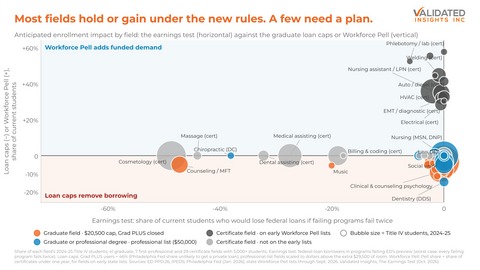
Most fields hold or gain under the new rules; a few need a plan. Earnings-test exposure (horizontal) against the graduate loan caps or Workforce Pell (vertical), by field. Bubble size = students, 2024-25. Source: Validated Insights, The Earnings Test.
“This effort to identify programs that currently fail or are near-misses is in part a wake-up call to institutions to analyze their programs now while there is time to take action to prevent failing the earnings test in 2027. The Earnings Test whitepaper also provides solutions, identifying seven levers that can move at-risk programs into a better position programmatically,” said Brady Colby, Head of Market Research at Validated Insights.
While individual program performance varies across institutions, degrees, and geographies, analysis in The Earnings Test whitepaper discovered several trends.
- 643,852 students are enrolled in the 2,880 failing programs; 308,207 of them borrow (3.8% of all federal borrowers) for their schooling.
- Of the 49,860 programs large enough to test (out of 209,321 in ED’s file), 2,880 fail and 1,995 pass by under 10%. Three-quarters of the programs are not measurable.
- Certificate programs face the greatest risk. 29% of the undergraduate certificate programs fail compared to 6.6% of associate degrees, 4.0% of master’s degrees, and 1.2% of bachelor’s degrees. 55% of the students in failing programs are in certificate programs.
- The exposed programs are specific and familiar. Many of the near-misses and failures are in health certificate fields, including medical and dental assisting. Other programs at risk include mental-health counseling, early-childhood associate degrees, human development associate degrees, fine arts bachelor’s, drama, and music master’s.
- Workforce Pell adds funded demand worth 28% – 45% of current students in the listed trades and nursing certificates, and the graduate caps take 3% – 9% from a handful of master’s programs – so most fields hold or gain.
“However, most of higher education is not at risk. Nursing degrees have no failing programs at any level,” added Colby. “The exposure in nursing sits in nursing assistant certificates, where 81 of 105 programs sit below the line once the test runs at six digits. The professional degrees sit at zero, too: medicine, law, pharmacy, dentistry, physical therapy, and veterinary medicine, with chiropractic being the one exception. MBAs, HVAC certificates, electricians, welders, engineering, computing, business, criminal justice, psychology, and teacher-preparation programs fail at 1% or less.”
Among those levers:
- Build the ladder to the next in-field credential. Laddering certificate programs up to a higher credential, shows significant gains in earnings.
- Use certification for placement and design for the second credential. Certified medical assistants earn 4.2% more than non-certified (AAMA); certified dental assistants earn 15% more (DANB) than non-certified. Coders with two credentials average a pay rate of $71,130 against $62,689 for coders with one credential (AAPC).
- Paid work-based learning adds to first-year salary. NCES data shows the paid-internship effect persists for four years.
- Place completers where the occupation pays. Coders placed in a hospital earn more than coders placed in physician offices. Part-time work also pulls the median down; therefore, track full-time status as a program KPI.
- Add the skills employers are willing to pay for. Employees with second-language skills, AI skills, and cognitive-plus-social skill combinations earn more so add these skills to at-risk programs. A skill add-on alone is worth 0% to 3%; a specialty setting or track, 4% to 9%; a credential step — for example, biller to coder, counselor to licensed counselor, fine arts to graphic design — 9% to 28%.
- Do not expect program length to help. There was no detectable effect on earnings when hours to completion increased. Length is a debt and completion lever, not an earnings-test lever.
- Manage scale, modality, and classification. In the exposed certificate fields, the largest programs fail at 1.4 to 2.7 times the rate of the smallest, and programs taught mostly online fail 15 to 20 points more often. Read your six-digit code: a field that passes at four digits can fail at six.
“The Department of Education’s first determination comes in early 2027 on students who completed in 2021 and the earliest that a program can lose loans is 2028-29 – after two failures in three years,” said Colby. “Now is the time to run program numbers and work on at-risk programs. Efforts to support job placement, improved completion rates, and moving students into laddered or increased credential choices can have a measurable effect. Programs are not powerless.”
Validated Insights is providing diagnostic reports for schools and institutions seeking to benchmark their programs against their state’s earnings reports. The 81-page report and accompanying report card plus case studies on psychiatric mental health nurse practitioner, social work bachelor’s, medical assisting, liberal arts associate degrees, and nursing assistant certificates, is available to download.
How the Earnings Test Analysis Was Completed:
The Earnings Test whitepaper is a collaborative effort using custom code from Anthropic’s Claude with analysis parameters, research questions, and analyst oversight from Validated Insights. The following data sets were aggregated and analyzed: six Education Department PPD:26 files covering 209,321 programs, the BLS OEWS metropolitan and nonmetropolitan wage files, the Burning Glass Credential Value Index, Payscale Pay-By-Skill Data, the Philadelphia Fed’s January 2026 study of graduate borrowing above the new loan caps, National Student Clearinghouse Transfer Data, IPEDS, CACREP, and the program-level debt fields in PPD:26.
To receive future reports from Validated Insights, follow Higher Ed News by VI on LinkedIn.
About Validated Insights
Validated Insights is an agile marketing agency specializing in helping higher education institutions achieve and exceed their goals. With a comprehensive suite of services, including digital marketing, paid search, paid social, and web strategy, Validated Insights delivers data-driven strategies and measurable results. The agency’s agile testing approach enables short- and long-term growth through better creative, strategy, media execution and continuous brand building. Validated Insights is the only agency in the higher education space to offer a performance guarantee in KPIs in the first 60 days – and continuous growth beyond that.
View source version on businesswire.com: https://www.businesswire.com/news/home/20261022185325/en/
Media gallery