
People Counting System Market to Witness 12.3% CAGR Through 2035 as Digital Monitoring Advances
People Counting System Market Size, Share and Research Report By Technology (Video-Based (2D/3D Stereo-Vision), Thermal
Press Release Disclaimer: This is a press release distributed through the XPR Media network. It has not been independently verified by our newsroom.

People Counting System Market Size, Share and Research Report By Technology (Video-Based (2D/3D Stereo-Vision), Thermal Imaging, Infrared Beam, Wi-Fi)
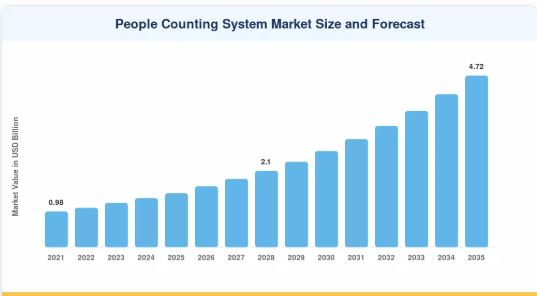
NEW YORK,, NY, UNITED STATES, August 20, 2026 /EINPresswire.com/ — The Global People Counting System market reached an estimated USD 1.48 billion in 2025 and is projected to grow from USD 1.66 billion in 2026 to USD 4.72 billion by 2035, registering a CAGR of 12.3% during the forecast period. Two catalysts are accelerating this trajectory: post-pandemic occupancy mandates that now persist as permanent building codes in over 30 countries, and the rapid adoption of AI-powered analytics platforms by retailers seeking real-time conversion-rate visibility.
The market has moved well beyond simple beam-break counters into a sophisticated sensor-fusion discipline. The market’s 12.3% CAGR reflects the convergence of AI and deep-learning video analytics (22% impact), smart-building occupancy regulations (18%), retail omnichannel conversion analytics (16%), and mass-transit passenger flow management (14%) accelerating across the world’s largest retail and smart-infrastructure economies simultaneously.
Legacy infrared beam and manual clicker systems once the backbone of retail traffic measurement are being replaced by 3D stereo-vision cameras, thermal sensors, and deep-learning video analytics capable of differentiating adults from children, staff from visitors, and even tracking dwell-time patterns across zones. The European Union’s revised Energy Performance of Buildings Directive, which ties ventilation automation to real-time occupancy data, has created a regulatory pull worth an estimated USD 420 million in retrofit sensor demand through 2030. North America commands roughly 38% of the market, driven by dense retail infrastructure and smart-building investment.
Asia-Pacific is the fastest-growing region at a projected CAGR of 14.8%, fueled by China’s smart-city rollouts and India’s metro-rail expansion. Europe holds the second-largest share at approximately 28%, anchored by GDPR-compliant privacy-by-design sensor architectures. As edge AI chips fall below the USD 5 price point, even mid-tier retailers in emerging economies will find deployment economics compelling by 2028.
Get Full PDF Sample Copy of Report: (Including Full TOC, List of Tables & Figures, Chart) @
https://www.marketresearchfuture.com/sample_request/2739
➤ How Significant Is the People Counting System Market’s Growth?
The people counting system market’s trajectory from USD 1.48 billion in 2025 to a projected USD 4.72 billion by 2035 represents more than a three-fold expansion over the forecast decade, reflecting the structural shift from simple beam-break counters toward AI-powered, sensor-fusion platforms capable of differentiating visitor types and tracking behavioral patterns across retail, transit, and building environments.
The market’s 12.3% CAGR is anchored in a regulatory-and-analytics super cycle where smart-building occupancy codes, retail conversion analytics, and mass-transit passenger management are all converging to make people counting infrastructure a standard specification rather than a discretionary add-on.
Video-based counting, spanning 2D and 3D stereo-vision, holds the dominant technology share at approximately 42% of the market, propelled by advances in on-camera neural processing, while thermal imaging sensors are expanding at the fastest technology CAGR of 14.1%, driven by privacy-sensitive deployments in healthcare and government facilities. Wi-Fi and Bluetooth proximity counting captures roughly USD 207 million in 2025 revenue, primarily within large-format venues and airports. By end user, retail remains the largest vertical, accounting for 35% of global demand, while transportation hubs represent the fastest-growing end-user segment at a CAGR of 13.6% as mass-transit authorities invest in real-time passenger flow management.
➤ What Does the Future Hold for the People Counting System Market?
AI and deep-learning video analytics contribute approximately 22% of driver impact to the people counting system market’s growth the single highest driver impact. Convolutional neural network integration directly onto counting cameras is the single most revolutionary factor driving the market. Beam-break sensors have never been able to match the 98.5% accuracy of real-time human detection made possible by NVIDIA’s Jetson Orin Nano platform, available for less than USD 200. Within the first quarter of installation, retailers using AI-based counters report a 15–20% increase in staff scheduling efficiency, resulting in ROI payback durations of less than 14 months.
Smart-building occupancy regulations contribute approximately 18% of driver impact, establishing regulatory compliance as a primary structural demand source. With effect from 2025, the EU’s EPBD recast requires all new commercial buildings larger than 500 square meters to have demand-controlled ventilation connected to real-time occupancy sensors, a rule that impacts an estimated 1.2 million buildings throughout the EU-27.
Occupancy-responsive ventilation is also encouraged in the U.S. by ASHRAE Standard 62.1-2022, with occupancy sensor data now referenced as a compliance method in California Title 24 and New York Local Law 97. Retail omnichannel conversion analytics adds a further 16% of impact as physical retailers under competitive pressure from e-commerce treat in-store traffic data the way digital marketers treat website clicks, with the National Retail Federation estimating that retailers using integrated counting and POS analytics saw a 12% uplift in same-store sales through labor and merchandising optimization in 2024.
The next phase of the market’s evolution centers on edge AI and on-device intelligence, with the migration of neural network inference from cloud servers to edge processors embedded within counting cameras defining the market’s next chapter; by 2028, an estimated 75% of new video-based counting deployments will process data entirely on-device, eliminating cloud bandwidth costs and addressing privacy concerns simultaneously.
Standalone counting hardware is also evolving into a data layer within broader spatial intelligence platforms that combine occupancy data with POS transactions, HVAC controls, and digital signage triggers, with the market increasingly valued by annual recurring analytics revenue rather than sensor units shipped. As corporations face mandatory ESG disclosures under frameworks such as the EU’s Corporate Sustainability Reporting Directive, which affects over 50,000 companies from 2025, occupancy data becomes essential for calculating per-capita energy intensity metrics, positioning the market at the intersection of operational technology and sustainability reporting a position that ensures demand persistence regardless of economic cycles.
Get access to the full description of the report @
https://www.marketresearchfuture.com/reports/people-counting-system-market-2739
➤ Who Are the Key Players in the People Counting System Market?
The people counting system market is moderately fragmented, with an estimated Herfindahl-Hirschman Index below 800 and the top five players collectively holding approximately 32–38% of global revenue. Competition spans specialized pure-play counting vendors, diversified surveillance-camera manufacturers adding counting features, and analytics-first software platforms integrating third-party sensors. MRFR identifies the following key participants with estimated revenue share ranges:
★ RetailNext (~6–9% share) – a full-stack retail analytics leader providing the Aurora sensor suite and a cloud analytics platform, positioned as the entry point for chains layering conversion-rate and staffing optimization onto raw count data.
★ Axis Communications (~5–8% share) – a surveillance-integrated counting specialist offering the P8815-2 3D counter and ACAP analytics, having released an ACAP-based occupancy analytics application in March 2025 that lets existing P-series cameras add counting capability without new hardware.
★ Xovis (~4–7% share) – a premium-accuracy, transport-focused provider offering the PC2S stereo sensor and flow monitoring, having deployed over 4,000 stereoscopic counting sensors across Singapore’s MRT stations in 2023 to reduce platform overcrowding.
★ DILAX (~3–6% share) – a European transit specialist providing DCS sensors and transit analytics, positioned as a privacy-by-design leader for GDPR-constrained on-device counting architectures.
★ Hikvision (~4–7% share) – a price-competitive, broad-portfolio provider offering DeepinView counters and AI NVRs, having introduced dual-lens counters with on-device privacy masking at under USD 400 per unit in November 2024 to target price-sensitive emerging markets.
★ SensMax (~2–4% share) – a budget-tier provider with an Eastern Europe focus offering the SensMax TAC-B radar counters, serving cost-conscious deployments across the region.
★ Teledyne FLIR (~3–5% share) – a thermal-and-stereo hybrid specialist providing Brickstream 3D+ sensors, serving privacy-sensitive healthcare and government deployments requiring non-visual detection methods.
★ ShopperTrak (Sensormatic / Johnson Controls) (~5–8% share) – a legacy retail installed-base leader offering thermal and video counters with analytics, having integrated its counting data with Johnson Controls’ OpenBlue building management platform in August 2024 to create a unified occupancy and energy optimization dashboard.
★ V-Count (~2–4% share) – a cloud-native, SME-oriented provider offering the Ultima AI and Ultima Go sensors, positioned to serve smaller retail and commercial customers seeking subscription-based deployment economics.
★ FootfallCam (~2–3% share) – an API-first, integrator-friendly provider offering the 3D Pro2 counter and Centroid software, serving system integrators building custom analytics on top of counting hardware.
Strategic competition in the people counting system market is increasingly defined by on-device privacy-preserving architectures and platform-economics data monetization with privacy and data protection regulations cited as a top structural headwind, contributing an estimated -15% negative impact on CAGR as GDPR and U.S. state-level biometric privacy laws such as Illinois BIPA and Texas CUBI are expected to increase video-deployment compliance costs by 18–25%, alongside high upfront deployment costs for SMEs, integration complexity with legacy building management systems, accuracy degradation in extreme environmental conditions, and cybersecurity vulnerabilities in IoT-connected sensors.
➤ What Are the Emerging Trends in the People Counting System Market?
Several transformational trends are redefining the people counting system market’s evolution through 2035:
AI and Deep-Learning Video Analytics: On-camera neural network integration now delivers 98.5% real-time human detection accuracy using processors like NVIDIA’s Jetson Orin Nano, priced under USD 200, driving retailers adopting AI-based counters to report 15–20% gains in staff scheduling efficiency within a single quarter.
Smart-Building Occupancy Regulations: The EU’s EPBD recast requires demand-controlled ventilation connected to real-time occupancy sensors in all new commercial buildings above 500 square meters, impacting an estimated 1.2 million buildings across the EU-27, reinforced by ASHRAE 62.1-2022 and state codes like California Title 24 in the U.S.
Retail Omnichannel Conversion Analytics: Physical retailers are treating in-store traffic data as a boardroom KPI equivalent to website clicks, with the National Retail Federation estimating a 12% uplift in same-store sales for retailers using integrated counting and POS analytics in 2024.
Counting-as-a-Service Subscription Models: Cloud-connected counting platforms offering monthly per-door pricing between USD 50 and USD 120 are gaining traction, unlocking the SME segment previously priced out by upfront hardware costs, with SaaS-model revenue projected to exceed 35% of total sales by 2030.
Emerging-Market Smart-City Deployments: India’s Smart Cities Mission has earmarked over USD 7.5 billion for urban infrastructure digitization across 100 cities, with passenger counting in metro stations and bus rapid transit corridors identified as priority use cases, alongside similar mega-projects in Saudi Arabia and Brazil.
Buy Full Research Report:
https://www.marketresearchfuture.com/checkout?currency=one_user-USD&report_id=2739
➤ How Is the People Counting System Market Segmented?
The people counting system market report provides a comprehensive segmentation framework:
By Technology: Video-Based / 2D-3D Stereo-Vision (42% share, 2025), Thermal Imaging (14.1% CAGR), Infrared Beam (USD 266 million, 2025), Wi-Fi / Bluetooth Proximity (11.8% CAGR), LiDAR and Radar (USD 74 million, 2025)
By End User: Retail (35% share, 2025), Transportation (13.6% CAGR), Hospitality & Entertainment (USD 222 million, 2025), Corporate / Commercial Buildings (12.8% CAGR), Government & Public Spaces (10% share, 2025), Others — Healthcare, Education (USD 74 million, 2025)
By Offering: Hardware, Software, Services
By Deployment Mode: On-Premise, Cloud
By Connectivity: Wired — Ethernet / PoE, Wireless — Wi-Fi, LP-WAN — LoRa, Zigbee, BLE
By Region: North America (38% share, 2025), Europe (USD 414 million, 2025), Asia-Pacific (14.8% CAGR), South America (USD 89 million, 2025), Middle East & Africa (13.2% CAGR)
➤ What Are the Regional Insights from the People Counting System Market?
North America leads the people counting system market with a 38% revenue share in 2025, anchored by the United States, which commands 82% of regional share as the region’s mature retail sector where chains like Walmart, Target, and Macy’s have made footfall analytics a standard component of store performance dashboards. The U.S. Department of Energy’s Better Buildings Initiative further incentivizes occupancy-responsive HVAC controls, pulling counting sensors into the commercial real-estate ecosystem. Canada is growing at an 11.6% CAGR through transit authority modernization, and Mexico contributed USD 18 million through shopping-center expansion.
Europe accounts for USD 414 million of the people counting system market in 2025, uniquely shaped by the tension between data-rich analytics ambition and GDPR-driven privacy constraints. This regulatory environment has given European vendors like Xovis and DILAX a competitive edge in privacy-by-design architectures that process counting on-device without transmitting identifiable imagery. Germany commands 24% of regional share through Industry 4.0 factory-floor monitoring, the United Kingdom is growing at a 12.5% CAGR through high-street retail transformation, France contributed USD 62 million through transport hub security, and the rest of Europe holds 34% of regional share through Nordic smart-building mandates.
Asia-Pacific is projected to register the highest regional CAGR of 14.8% through 2035, reflecting a convergence of government-funded mass-transit projects and an expanding organized retail sector. China commands 46% of regional share through smart-city surveillance and retail-chain deployment, with its 14th Five-Year Plan allocating over USD 12 billion to smart-city infrastructure and pedestrian flow monitoring explicitly listed as a priority technology vertical. India is posting a 16.2% CAGR within the region through metro-rail expansion and its Smart Cities Mission, Japan contributed USD 48 million through aged-care and retail labor optimization, South Korea is growing at a 13.8% CAGR through 5G-connected retail analytics, and the rest of Asia-Pacific holds 18% of regional share through Southeast Asian retail expansion.
South America and the Middle East & Africa round out the people counting system market’s regional footprint. Brazil commands 58% of South American revenue through its extensive network of shopping centers, the fifth-largest globally, and bus rapid transit corridors in cities like Curitiba and São Paulo that increasingly require automated passenger load data for fare optimization, while the rest of South America is growing at an 11.4% CAGR through airport modernization. In the Middle East & Africa, the UAE commands 32% of regional share through mall-of-the-future and expo venue deployments, Saudi Arabia is growing at a 14.5% CAGR through NEOM, Riyadh Metro, and Vision 2030 mega-projects with its Riyadh Metro’s 85 stations across six lines specifying real-time passenger counting as a contractual requirement during its 2023 procurement phase, and the rest of MEA contributed USD 36 million through Hajj crowd management and airport expansion.
➤➤➤ Industry Analysis Reports by Market Research Future:
Hi-Fi Speaker System Market
https://www.marketresearchfuture.com/reports/hi-fi-speaker-system-market-4598
Autonomous Mobile Manipulator Robots Market
https://www.marketresearchfuture.com/reports/autonomous-mobile-manipulator-robots-ammr-market-10809
Smart Cameras Market
https://www.marketresearchfuture.com/reports/smart-cameras-market-1326
Smart Indoor Lighting Market
https://www.marketresearchfuture.com/reports/smart-indoor-lighting-market-3780
Digital Process Automation Market
https://www.marketresearchfuture.com/reports/digital-process-automation-market-6651
Android Stb And Tv Market
https://www.marketresearchfuture.com/reports/android-stb-tv-market-10332
Europe Advanced Co2 Sensor Market
https://www.marketresearchfuture.com/reports/europe-advanced-co2-sensor-market-2574
Collision Avoidance Sensors Market
https://www.marketresearchfuture.com/reports/collision-avoidance-sensors-market-8167
Serdes Market
https://www.marketresearchfuture.com/reports/serdes-market-7428
Power Amplifier Market
https://www.marketresearchfuture.com/reports/power-amplifier-market-1705
Sagar Kadam
Market Research Future
+ +1 628-258-0071
email us here
Legal Disclaimer:
EIN Presswire provides this news content “as is” without warranty of any kind. We do not accept any responsibility or liability
for the accuracy, content, images, videos, licenses, completeness, legality, or reliability of the information contained in this
article. If you have any complaints or copyright issues related to this article, kindly contact the author above.

Media gallery


