
Scientists report low-cost approach to hydrogen production from seawater
New research shows that low-cost production of hydrogen from seawater and on an industrial scale is possible. SHARJAH,
Press Release Disclaimer: This is a press release distributed through the XPR Media network. It has not been independently verified by our newsroom.

New research shows that low-cost production of hydrogen from seawater and on an industrial scale is possible.
SHARJAH, UNITED ARAB EMIRATES, October 26, 2026 /EINPresswire.com/ — By Ifath Arwah, University of Sharjah
Using a range of advanced characterization techniques, researchers say they have developed a novel method with the potential to produce hydrogen from seawater using a process that requires less energy, resists corrosion, and could support more economical hydrogen production.
The study, published in the journal Chemical Communications, describes the use of a new catalyst to produce hydrogen. The catalyst is composed of three ingredients: nickel hydroxide, cerium oxide, and phosphate. The catalyst components are abundantly available in nature and relatively inexpensive to obtain.
One of the most promising ways to produce clean hydrogen fuel is water electrolysis, which runs electricity through water to split it into hydrogen and oxygen. Currently, this process is usually carried out using pure, treated water, which is expensive and, in many parts of the world, scarce. Seawater is abundant and readily available, so scientists have long wanted to use it directly for hydrogen production.
However, seawater contains large amounts of chloride ions (dissolved salt). These ions create two major challenges: they corrode and degrade the metal catalysts that drive the reaction, and they compete with the desired oxygen-evolution reaction.
“Instead of producing oxygen cleanly, the reaction can produce toxic chlorine and related byproducts,” explained Dr. Tanveer Ul Haq, assistant professor of chemistry at the University of Sharjah and a co-author. “So, the challenge isn’t just ‘can we split seawater?’ It’s ‘Can we do it selectively and durably, without the salt wrecking the catalyst or hijacking the reaction? ’”
Fresh step toward affordable hydrogen
According to the study, the new catalyst system requires less energy to operate, is more selective for the desired reaction, and corrodes far less than versions lacking either cerium oxide or the phosphate.
The authors also attribute durability to their method, maintaining that it remains effective for longer periods under real operating conditions than earlier models.
“In a stress test, it ran continuously at high output for about 80 hours in simulated seawater without breaking down or losing performance—a good sign of practical durability, not just a one-off lab result,” noted Dr. Ul Haq.
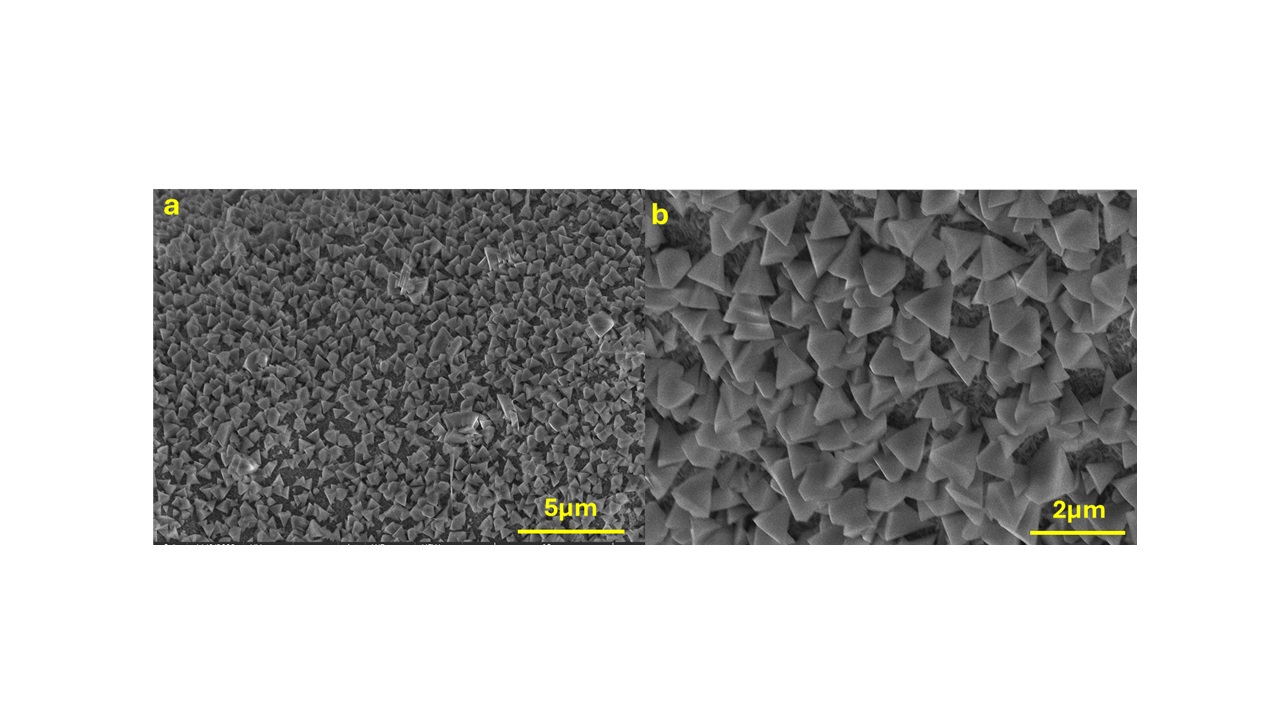
In addition, he noted that the material formed tiny, densely packed, pyramid-shaped nanostructures, giving the catalyst a significantly larger active surface area than plain nickel hydroxide, meaning more sites where the reaction can occur.
The authors demonstrate a catalyst that operates efficiently and durably directly in seawater, which accounts for roughly 97% of the planet’s water. “This kind of research chips away at one of the practical bottlenecks standing between ‘green hydrogen is theoretically great’ and ‘green hydrogen is something we can actually build at scale, everywhere, cheaply,’” Dr. Ul Haq emphasized. “It’s not a finished commercial product yet, but it’s a solid, well-documented step in that direction.”
Another payoff, according to the authors, is that their technique does not rely on fossil fuels to operate. They describe it as an effort to make the entire operation “green,” producing hydrogen with renewable electricity in a manner that is both affordable and scalable.
Hydrogen today is widely seen as a key component of decarbonizing industries that are difficult to electrify directly, such as steelmaking, shipping, and heavy trucking. However, most hydrogen is currently produced either through fossil-fuel-based processes or through processes that depend on relatively scarce and not readily available clean water.
Big hydrogen potential
Asked about the potential benefits for renewable-energy industries, Ul Haq said that one of the most direct payoffs of their method was cost-effectiveness and simplicity.
“If catalysts like this one can reliably run on untreated or lightly treated seawater rather than purified water, it would remove a major cost and infrastructure burden from green hydrogen production, with no need for expensive desalination or water purification just to feed an electrolyzer,” he added. “That’s especially valuable for coastal industrial facilities, island nations, or any region near the ocean but short on fresh water.”
The authors’ catalyst is particularly significant as the hydrogen production industry is engaged in a concerted push toward affordable, earth-abundant metal catalysts. Currently, many top-performing water-splitting catalysts rely on rare and expensive metals such as platinum or iridium.
The authors use nickel, an abundant and inexpensive material; cerium, which is modestly available; and phosphate, an extremely common and low-cost component. Dr. Ul Haq described the combination as “far more realistic to manufacture at an industrial scale” than many other alternatives now used by the industry.
Another advantage, according to the authors, is that their technology is considerably more resistant to corrosion in saline environments, whereas many existing catalysts degrade rapidly in real seawater, rendering them commercially unviable.
Despite these advantages, the authors make it clear that their catalytic system has demonstrated stable operation for 80 hours, which is short of what a commercial-scale plant would ultimately require.
“Nonetheless, it is a meaningful early signal that the corrosion-resistance strategy holds up under realistic, salty conditions rather than just in theory,” concluded Dr. Ul Haq.
Original Source URL: https://doi.org/10.1039/d6cc02785g
LEON BARKHO
University Of Sharjah
+971 50 165 4376
Legal Disclaimer:
EIN Presswire provides this news content “as is” without warranty of any kind. We do not accept any responsibility or liability
for the accuracy, content, images, videos, licenses, completeness, legality, or reliability of the information contained in this
article. If you have any complaints or copyright issues related to this article, kindly contact the author above.

Media gallery
