
NUH OPHTHALMOLOGY AT 40: FOUR DECADES OF TRANSFORMING EYE CARE
SINGAPORE, Oct. 23, 2026
Press Release Disclaimer: This is a press release distributed through the XPR Media network. It has not been independently verified by our newsroom.

NUH OPHTHALMOLOGY AT 40: FOUR DECADES OF TRANSFORMING EYE CARE
PR Newswire
SINGAPORE, Oct. 23, 2026
The Department marks its anniversary by spotlighting innovations in multidisciplinary and minimally invasive care, alongside a flagship international congress that fosters global collaboration in ophthalmology
SINGAPORE, Oct. 23, 2026 /PRNewswire/ — As the Department of Ophthalmology at the National University Hospital (NUH) marks its 40th anniversary, it is advancing care for complex eye conditions with two specialised services that build on four decades of clinical expertise.
The Eye and Rheumatology in Adults (ERA) Combined Clinic brings ophthalmologists and rheumatologists together to manage complex inflammatory eye diseases, while the dacryoendoscopy-guided Endoluminal Lacrimal Duct Recanalisation (ELDR) treatment offers a minimally invasive way to restore the eye’s natural tear drainage pathway. Both reflect the department’s continued drive to improve care through collaboration and innovation.
Preserving vision through multidisciplinary care
Uveitis is a relatively uncommon but potentially sight-threatening inflammatory eye condition that can cause eye pain, redness, sensitivity to light and blurred vision. If left untreated, it may lead to complications such as glaucoma in up to 20 per cent of patients and irreversible vision loss. Management can be complex, as some patients with severe or recurrent uveitis often have underlying autoimmune or rheumatological diseases requiring long term immunomodulatory therapy (IMT) to control inflammation and preserve vision.
To address these increasingly complex care needs, NUH established the Eye and Rheumatology in Adults (ERA) Combined Clinic in April 2026, following a pilot that commenced in January 2025. Held monthly, the clinic sees about 10 to 16 patients per session and has cared for more than 30 patients since its official launch this year. The clinic supports a subset of the approximately 40 to 50 uveitis patients managed by NUH Ophthalmology each week.
Designed for patients with complex uveitis who are starting or receiving IMT, the clinic brings together dual subspecialty trained eye surgeons, rheumatologists, nurse clinicians and pharmacists in a coordinated care model believed to be among the few of its kind in the world. With the uveitis service helmed by dual-trained eye surgeons with expertise in uveitis and related complications such as glaucoma and retinal disease, this structure has set us apart from traditional combined outfits found elsewhere globally, as it already offers a more integrated and efficient approach to patient care for Ophthalmology alone.
Prior to the establishment of the ERA Combined Clinic, patients typically attended separate ophthalmology and rheumatology appointments, with treatment decisions and medication adjustments often requiring follow-up discussions between care teams. For patients with complications such as glaucoma, this could mean up to three separate consultations across ophthalmology subspecialties and rheumatology, often on different days.
Today, patients see both specialists during a single visit, enabling real-time assessment of disease activity, treatment response and IMT optimisation. This allows treatment plans to be reviewed and adjusted promptly, rather than patients having to wait weeks and months for follow-up reviews or medication changes. The coordinated model also facilitates discussions on both ocular inflammation and extraocular manifestations, such as joint or lung involvement, enabling a more seamless and comprehensive approach to care.
The clinic is further supported by experienced nurse clinicians who provide patient education, medication counselling, vaccination support and training on the administration of immunomodulatory therapies, including self-administered injections. A dedicated pharmacy IMT team also reviews blood test results and advises patients on medication adjustments between visits when necessary, ensuring closer monitoring and continuity of care.
For the clinicians, this model eliminates the need for lengthy memos or phone calls, which can often delay care when specialists are unavailable. It also addresses the challenges of specialised medical terminology and deciphering ophthalmic documentation between different disciplines. The time saved can then be devoted to reducing patient wait times and helping patients improve the understanding of their own care journeys.
Dr Dawn Lim, Senior Consultant and Head of Ocular Immunology Service, Department of Ophthalmology, NUH, and one of the ERA Combined Clinic’s co-leads said: “The ERA Combined Clinic reflects years of collaboration between NUH’s Ophthalmology and Rheumatology departments. We redesigned how care is delivered for patients with complex uveitis. Rather than navigating multiple appointments and receiving treatment recommendations days later, patients are now able to benefit from coordinated specialist input within a single visit.” Dr Lim subspecialises in uveitis, glaucoma and complex cataract surgeries.
“The successful management of autoimmune diseases extends beyond prescribing medication alone. Patients require education, vaccination, laboratory monitoring and ongoing support to ensure treatment remains both effective and safe,” added the other co-lead of the Clinic, Adj A/Prof Manjari Lahiri, Senior Consultant, Division of Rheumatology and Allergy, Department of Medicine, NUH. “Through the ERA Combined Clinic, patients benefit from a multidisciplinary care team working together within a single coordinated pathway, providing a more seamless experience and closer monitoring throughout their treatment journey. Ultimately, this multidisciplinary approach leverages a team of experts with a shared objective to bring patient care to the next level of excellence.”
Pioneering new approaches to oculoplastic and tear duct conditions
The Orbit and Oculofacial team at NUH Ophthalmology has been at the forefront in cutting edge management of common and rare eyelid, tear duct and orbital disorders. Headed by a team with a cumulative experience of over 35 years, the service combines state-of-the-art technology and minimally invasive techniques with high patient satisfaction rates. Its expertise has drawn patients from the region and beyond, while also providing training for specialists from around the world.
One area where the team has advanced treatment is in the management of tear duct disorders. Excessive tearing is a common issue that patients seek treatment, and can affect daily activities such as reading, working and driving.
Traditional surgery for tear duct obstruction often involves creating a new drainage passage through bone, typically in the operating theatre under anaesthesia. In 2015, NUH Ophthalmology was one of the first in Singapore to introduce dacryoendoscopy-guided Endoluminal Lacrimal Duct Recanalisation (ELDR), a minimally invasive approach that identifies and clears blockages from within the eye’s natural tear drainage system. The service further advanced this approach in 2023 with the adoption of a newer, more flexible endoscope, enabling suitable patients to undergo the procedure on an outpatient basis with minimal anaesthesia and reducing the need for more invasive surgery.
Although performing ELDR as an outpatient procedure is relatively new in Singapore, dacryoendoscopy guided procedures have been well-established in Japan since early 2010s for patients with tear duct blockage. The procedure uses a fine endoscope, measuring less than 1 mm, which is inserted through the eye’s natural tear drainage system to directly identify and clear blockages within the tear ducts, helping tears drain normally again.
Unlike past conventional surgical approaches, dacryoendoscopy allows surgeons to directly visualise the site and nature of the tear duct obstruction, and restores the patients’ natural tear drainage channel without the need for more extensive surgery. Performed as an outpatient procedure, ELDR results in shorter procedure times with minimal surgical trauma, compared to conventional surgery which may take two to three times longer, while offering suitable patients a faster recovery. Since its introduction in 2023, more than 50 patients have undergone the procedure at NUH.
Dr Maryanne Chew Romero, Consultant, Department of Ophthalmology, NUH, said: “Many of our patients live with persistent tearing for months or even years, seeking help only when it becomes unbearable or leads to a serious infection. They may not realise that a narrowing or blockage in the tear drainage system is a common cause of tearing, and that treatment is available. With our minimally invasive dacryoendoscopy service, we hope to raise awareness and offer suitable patients a procedure that can be done in the clinic, without a trip to the operating theatre. By broadening the treatment options available to our patients, we can tailor the approach for each individual rather than offering everyone the same treatment.”
Adj A/Prof Gangadhara Sundar, Senior Consultant, Department of Ophthalmology, NUH, added: “Building this service has taken years of specialised training, experience and support from the department. Now that it is firmly established, we can offer suitable patients a gentler way to treat the problem, with less surgical trauma, a shorter recovery and, most importantly, relief from the tearing they may have lived with for years.”
Shaping ophthalmology beyond patient care
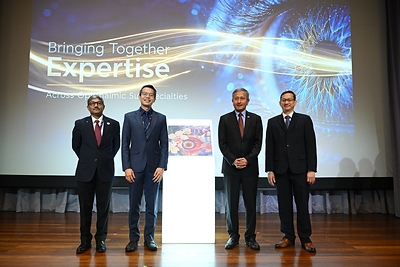
As part of its 40th anniversary celebrations, the Department of Ophthalmology at the NUH is commemorating four decades of advancing eye care through specialised clinical services, research and professional training. A key highlight of the milestone year is the NUH International Ophthalmology Scientific Congress (IOSC) 2026, the Department’s flagship biennial scientific meeting, held from 22 to 25 October 2026. With 374 national, regional and international delegates and 171 expert faculty from over 31 countries, this landmark scientific Ophthalmologic congress in Singapore and southeast Asia is poised to transform eye and general health care for years to come.
Beyond convening international experts to discuss the latest advances in eye care, IOSC 2026 will host the first-ever EUropean Group on Graves’ Orbitopathy (EUGOGO) Teaching Course outside Europe, a milestone that reflects NUH’s growing contribution to global ophthalmology and Singapore’s position as a gateway for collaboration across Asia and beyond.
Through patient care, research, education and international collaboration, NUH Ophthalmology remains committed to advancing the field while improving outcomes and quality of life for future generations of patients.
Chinese Glossary
|
National University Hospital (NUH) |
国立大学医院(国大医院) |
|
Eye and Rheumatology in Adults Combined Clinic |
眼科与风湿病联合门诊 |
|
Dr Dawn Lim Senior Consultant Department of Ophthalmology NUH |
林家红医生 高级顾问医生 眼科 国大医院 |
|
Adj A/Prof Manjari Lahiri Senior Consultant Division of Rheumatology and Allergy Department of Medicine NUH |
Manjari Lahiri客座副教授 高级顾问医生 风湿过敏科 国大医院 |
|
Adj A/Prof Gangadhara Sundar Senior Consultant Department of Ophthalmology NUH |
Gangadhara Sundar客座副教授 高级顾问医生 眼科 国大医院 |
|
Dr Maryanne Chew Romero Consultant Department of Ophthalmology NUH |
莉安医生 顾问医生 眼科 国大医院 |
About the National University Hospital (NUH)
The National University Hospital (NUH) is Singapore’s leading university hospital. While the hospital at Kent Ridge first received its patients on 24 June 1985, our legacy started from 1905, the date of the founding of what is today the NUS Yong Loo Lin School of Medicine. NUH is the principal teaching hospital of the medical school.
Our unique identity as a university hospital is a key attraction for healthcare professionals who aspire to do more than practise tertiary medical care. We offer an environment where research and teaching are an integral part of medicine, and continue to shape medicine and transform care for the community we care for.
We are an academic medical centre with over 1,200 beds, serving more than one million patients a year with over 50 medical, surgical and dental specialties. NUH is the only public and not-for-profit hospital in Singapore to provide trusted care for adults, women and children under one roof, including the only paediatric kidney and liver transplant programme in the country.
The NUH is a key member of the National University Health System (NUHS), one of three public healthcare clusters in Singapore. For more information, visit www.nuh.com.sg

 View original content to download multimedia:https://www.prnewswire.com/news-releases/nuh-ophthalmology-at-40-four-decades-of-transforming-eye-care-302917882.html
SOURCE National University Hospital (NUH)

